
Journal · November 2, 2026
Most empty lots in Brevard belong to people, not developers, and three of every four lot sales last year were in Palm Bay. Here is how to read a lot before you offer on it.
The 2026 preliminary tax roll classes 48,261 Brevard parcels as vacant residential land. 29,560 of them have a street address on the roll. Of those, 17,719, about 60%, are owned by individuals rather than companies or other organizations. Palm Bay has 20,977 of the addressed lots, and individuals own 13,721 of them.
They change hands, too. 2,134 of the county's addressed vacant lots sold in 2025 and were still empty on the 2026 roll. 1,579 of those sales, about 74%, were in Palm Bay. Rockledge had 127 and Port St. John 86. Another 428 Palm Bay lots that sold as vacant land in 2025 already show a house built in 2025 or later.
So the owner of the lot you want is more often a person than a land company.
Every parcel in the county has a record on the Brevard County Property Appraiser (BCPAO) website. Before you call the seller, read three things on it. The owner's name tells you who can sign. The use code should show vacant residential. And the legal description gives the subdivision, block and lot.
Don't count on a street address. 18,701 of the county's vacant residential parcels, 39%, have none on the roll. Search those by parcel ID or owner name. Some are ordinary house lots. Others are common areas, drainage tracts or slivers that were never meant to hold a house, so check the size and the legal description before you get attached.
In Palm Bay you will see "PORT MALABAR UNIT" at the front of most legal descriptions. Port Malabar is the big platted subdivision that covers most of the city: 43,346 of Palm Bay's 53,450 single-family homes carry the name, and so do 18,214 of its 20,977 addressed vacant lots (87%). It is also where most of the new houses go up. 8,112 of the 12,051 Palm Bay homes built since 2020 are on Port Malabar lots. The unit number tells you which section of the plat the lot is in. It doesn't tell you whether the street has sewer, how low the lot sits, or how much width the setbacks leave.
A developed lot sits on a paved road with power at the street, and sometimes city water and sewer. Raw land is everything short of that: trees to clear, low ground that may need fill, and a well and septic system to put in.
Septic is where this part of Florida has its own rule. Since January 1, 2024, inside the Banana River Lagoon, Central and North Indian River Lagoon and Mosquito Lagoon plan areas, a new septic system that wasn't already permitted can't be installed where sewer is available. Where it isn't, only an enhanced nutrient-reducing system, or another system that removes at least 65% of the nitrogen, is allowed. That is section 373.469(3)(d)1. of the Florida Statutes. Ask the city or county utility whether sewer is available at the lot, and ask whether the lot sits inside one of those plan areas, before you price a build.
Clearing, fill, drainage, the flood zone and the permit all belong on the list too. Our Palm Bay page has a six-point checklist that walks through them.
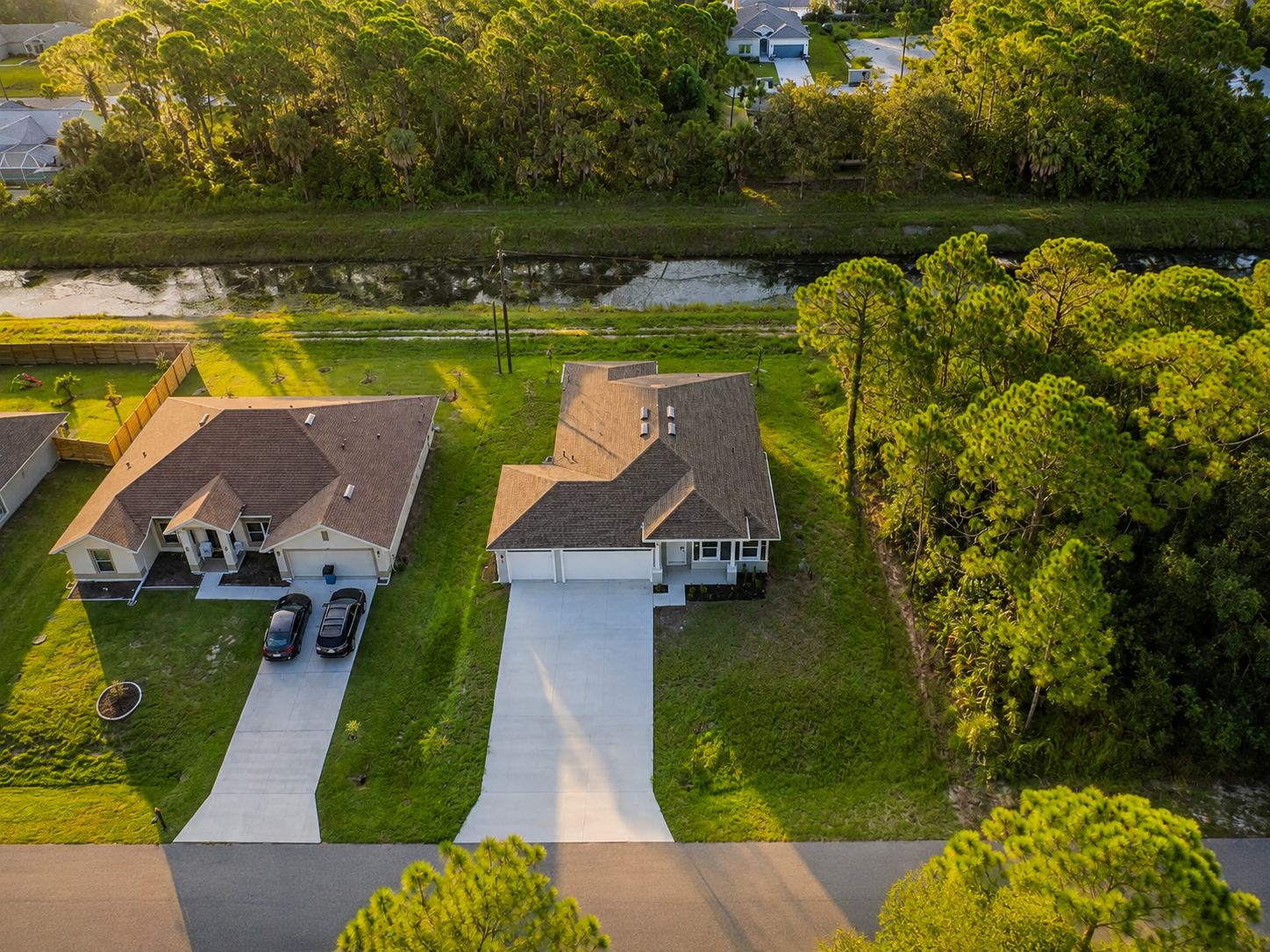
Closing on a lot works much like closing on a house. Use a title company or a real estate attorney. They search the title for liens and easements, and you should have a current boundary survey that shows the real corners. Florida charges documentary stamp tax on the deed at 70 cents per $100 of the price, under section 201.02(1)(a). Who pays it, along with title insurance and the other closing costs, is set by your contract.
Property tax stays on the land for a while after you start building. Florida assesses real property as of January 1, and an improvement that isn't substantially completed on that date gets no value, under section 192.042(1). If your house is still going up on January 1, that year's bill is for the land.
The plan has to fit the lot after the setbacks come out, and that matters most for wide houses and big garages. Two of our seven plans have an RV garage, the King Willow and the Tradesman, and the Tradesman's RV garage is 49 feet. An RV bay needs the width and the driveway the lot can actually give you.
Send us the address or parcel number before you sign, with the survey and flood zone if you have them, and we'll tell you which plans fit. If the lot needs work first, you will hear it before anything is drawn. If you are shopping north of Melbourne, our Rockledge and Port St. John pages show what the roll says about lots there.
You have three ways to use it with us. You can build on it: we match one of our plans to it, and buildable lot equity can go toward the house so you bring less cash to the table. You can trade it: if you don't want to build on that parcel, we may take it toward a finished home or a new build. Or you can sell it. We buy vacant lots, acreage and inherited land directly from owners in Brevard County through We Buy Land. The details of each are on The Gibraltar Difference.
Whichever it is, start the same way. Send the address or parcel number through our contact page or call (321) 401-6003, and we'll tell you where the lot stands.
Sources: Florida Department of Revenue, Brevard County 2026 preliminary tax roll (NAL) and sales file (SDF), counted November 2, 2026. A 2025 lot sale means a sale recorded as vacant land. "Individuals" means the owner name has no business or organization marker: LLC, Inc, Corp, LP and the like (also when the roll cuts a name off at 30 characters, as in "Florida LL"), a word such as Properties, Investments, Holdings, Realty, Developers or Construction, or a homebuilder, church, government or association name. Trusts and estates count as individuals unless the name carries one of those markers. Florida Statutes (2026), s. 373.469, s. 201.02 and s. 192.042.
Looking at a lot, or already own one? Send the address or parcel number and we'll tell you which plans fit and what the lot needs first.